

Build 10x products in minutes by chatting with AI - beyond just a prototype.
Topics
What is a client-side REST API?
Do I still need to know HTTP methods?
Can Rocket.new handle authentication?
Is manual API coding going away?
Why do apps update instantly without a refresh? Client-side APIs connect to REST services via HTTP methods like GET and POST, powering fast, responsive, intelligent web applications through auto-generated code today.
How do modern web apps fetch your profile, messages, or dashboard without reloading the page?
The answer is the client-side API, which talks to a REST API using HTTP methods such as GET and POST.
According to industry statistics , 93% of developers use REST APIs as their primary API architecture in their projects today. That’s a lot of clicks happening behind the scenes.
What’s cool is that browsers and frameworks can now generate client-side API code automatically. This code interacts with REST-based web services, making apps fast, responsive, and surprisingly smart.
So let’s see what this actually means.
A client-side API is essentially the middleman in your web app. It runs in the browser and handles client-side communication with the server. Its main jobs are simple: retrieve data, send data, update resources, and interpret status codes so the app knows what’s going on.
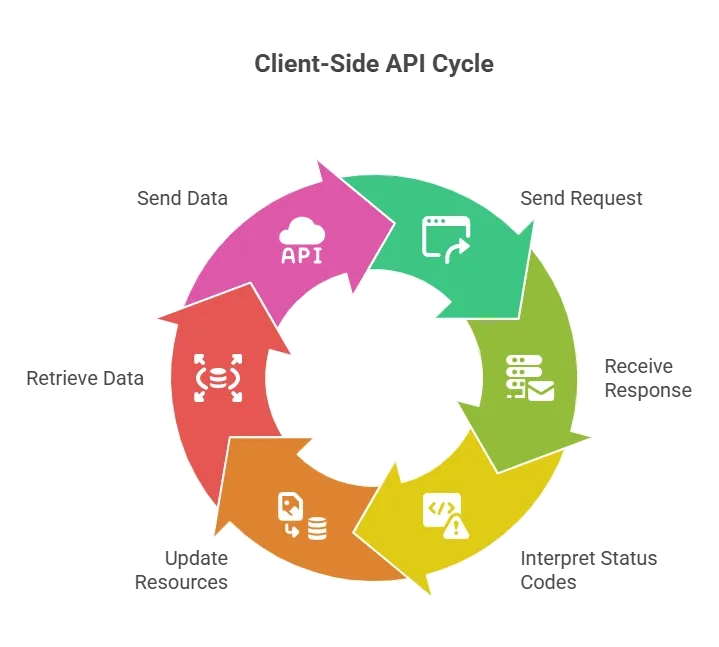
REST, or representational state transfer, is an architectural style that organizes how servers and clients communicate. Introduced by Roy Fielding, REST defines a set of architectural constraints that make APIs predictable and scalable.
Here’s the gist:
Basically, REST is a framework for keeping your communication protocol sane. It’s the plumbing that delivers your data where it needs to go, without surprise leaks or errors.
So what does client-side REST API generation actually do?
Imagine you have a web services backend. Each endpoint handles resources like users, posts, or messages.
A generator tool reads the API definition and produces client-side functions like:
getUsers() createPost(data) deleteComment(id)
The result? No more repetitive code and fewer chances of mismatch between server and client. Your front-end can focus on UI while the client-side API handles networking like a pro.
Before diving into code, it helps to understand the basic HTTP methods that power every REST API. Think of them as the verbs your client-side API uses to tell the server what you want to do, whether it’s fetching, creating, updating, or deleting resources.
| HTTP Method | Purpose | Example |
|---|---|---|
| GET | Retrieve data | Fetch user profile |
| POST | Send data | Create new post |
| PUT | Replace data | Update profile |
| PATCH | Modify partially | Change password |
| DELETE | Remove resource | Delete comment |
These HTTP methods form the language of REST API interactions, making it easy for API developers to predict and manage responses.
Picture a dashboard app. When you click “Show Users”:
This is repeated for send data, update, or delete operations. If a status code such as 404 or 500 is returned, the generated code handles it gracefully, displaying errors to users rather than crashing the app.
Developers know the struggle of keeping client and server in sync. One Reddit user shared:
“The challenge in REST client development is keeping client code in sync with API specs. Tools like OpenAPI Generator help reduce errors by generating client code from the API definition.” Reddit,
Basically, the client-side API is like a middle manager, boring but indispensable.
Modern web apps are expected to:
Without client-side API code, this would be a mess. Generated code keeps everything structured while developers focus on features. Think of it as setting your Wi-Fi router once instead of rebooting it every day.
This is where Rocket.new shines. It’s a vibe solutions platform that can generate full apps, including frontend, backend, and client-side API code, from simple descriptions.
Basically, you describe what you want, and Rocket does the plumbing. Your client code comes ready to go.
In a typical system architecture today:
This combination ensures the app stays responsive and consistent across different systems or browsers.
Even when everything looks smooth in a web app, there’s a lot happening behind the scenes. The client-side API is the unsung hero that keeps your app responsive and organized. Without it, your app might feel clunky, slow, or unpredictable.
Key Roles of Client-Side API:
Think of the client-side API as the conductor of your web app orchestra. It quietly manages the rhythm, ensures every component hits the right note, and keeps your users happily engaged all without drawing attention to itself.
Handwriting client API code is tedious and prone to errors. Synchronizing it with server updates is a nightmare. Use auto-generation tools, or platforms like Rocket.new, to produce ready-to-use client-side API code that handles requests, resources, status codes, and session state.
Modern web development doesn’t have to mean drowning in network code. A well-generated client-side API keeps your app smooth, fast, and reliable while letting developers focus on making the UI delightful.