

Production-ready Apps in Minutes
What is a postmates clone script used for?
Can one postmates clone app handle multiple delivery categories?
Is postmates clone app development expensive?
What are the advanced features experts usually integrate?
Looking for the fastest way to launch your delivery startup with a Postmates clone? This blog shows how ready-made apps let you enter the market quickly without coding or huge costs. Find out which clone solutions truly deliver results and help you start earning in record time.
Launching a delivery startup today goes far beyond building an app or hiring a few drivers.
It’s about managing real time logistics, handling multiple order types, and creating a smooth experience for every user. Many founders know how challenging that balance can be.
So, how can you build a delivery platform that grows quickly while still staying under your control?
A Postmates clone offers a ready foundation to move quickly while keeping flexibility in your hands.
In this blog, we’ll look at what makes certain clone solutions stand out and how they help you launch smarter from both a technical and strategic angle.
Experienced founders know speed matters.
The faster you enter the market, the sooner you can test demand and refine your delivery process. A strong clone app doesn’t only replicate functionality, it provides the architecture to customize and evolve. The online food delivery market has become fiercely competitive, and the line between a successful launch and a slow rollout can define a company’s future.
A Postmates clone app offers an operational backbone built for scalability. It handles order requests, dispatches delivery drivers intelligently, manages store owners efficiently, and syncs all data into a clean admin dashboard. The best part is how quickly you can modify it to your brand identity and integrate it into a larger multi-delivery business setup.
So, if you already understand delivery logistics and customer acquisition, your next focus should be technology that lets you iterate fast. That’s where these clone solutions shine.
The first thing you notice when evaluating a clone app is how balanced it feels between flexibility and structure. You don’t need a basic script. You need a fully customizable foundation that works for food delivery, grocery delivery, or a full multi delivery business.
| Module | Core Components and Description |
|---|---|
| Customer App | Smooth onboarding, order request management, payment gateways, real time tracking, and clear order history |
| Driver App | Optimized route suggestions, order details, delivery confirmation, delivery routes view, and earning summaries |
| Store App | Inventory management, acceptance of new orders, delivery process control, order details and analytics overview |
| Admin Dashboard | Control of delivery services, driver allocation, customer management, promo codes setup, and insights dashboard |
Each component must run as part of a connected ecosystem. The architecture should enable users to navigate intuitively, while the backend maintains data accuracy and synchronizes data across all apps.
A well built Postmates clone app should also deliver:
A Postmates clone is not one app. It’s a set of apps that communicate in milliseconds. For experts building such systems, data orchestration between modules is critical. Below is the workflow representation.
This cycle repeats thousands of times per day. The efficiency of your postmates clone app depends on how well each step communicates with the next. An optimized data model, scalable API infrastructure, and asynchronous processing make the difference between a delivery that feels instant and one that feels lagged.
Founders with technical teams should look for flexibility in stack choices and infrastructure. The app must support evolving requirements over time without bottlenecks.
Your architecture should support fast scaling when the number of delivery drivers and customer requests spikes. An app runs smoothly only if you anticipate these operational loads early.
A Postmates clone script isn’t a static product. It’s a flexible blueprint that evolves with your operations. With a reliable script, you can integrate store, driver, and customer apps under a single admin-supervised model. This enables real time analytics on order requests, fulfillment rates, and delivery efficiency.
This structure gives clarity to communication paths. Delivery providers see the full order pipeline from order details to payment confirmation and store owners can manage their own dashboards. Such connected architecture is the core of a fully customizable platform that sustains business growth.
A white label Postmates clone allows faster brand deployment. You can customize design, logo, theme, and service structure without altering backend logic.
But there’s a catch. Not all scripts are equally extensible. Make sure your provider allows code access and future integrations. For advanced players, this transparency is non negotiable.
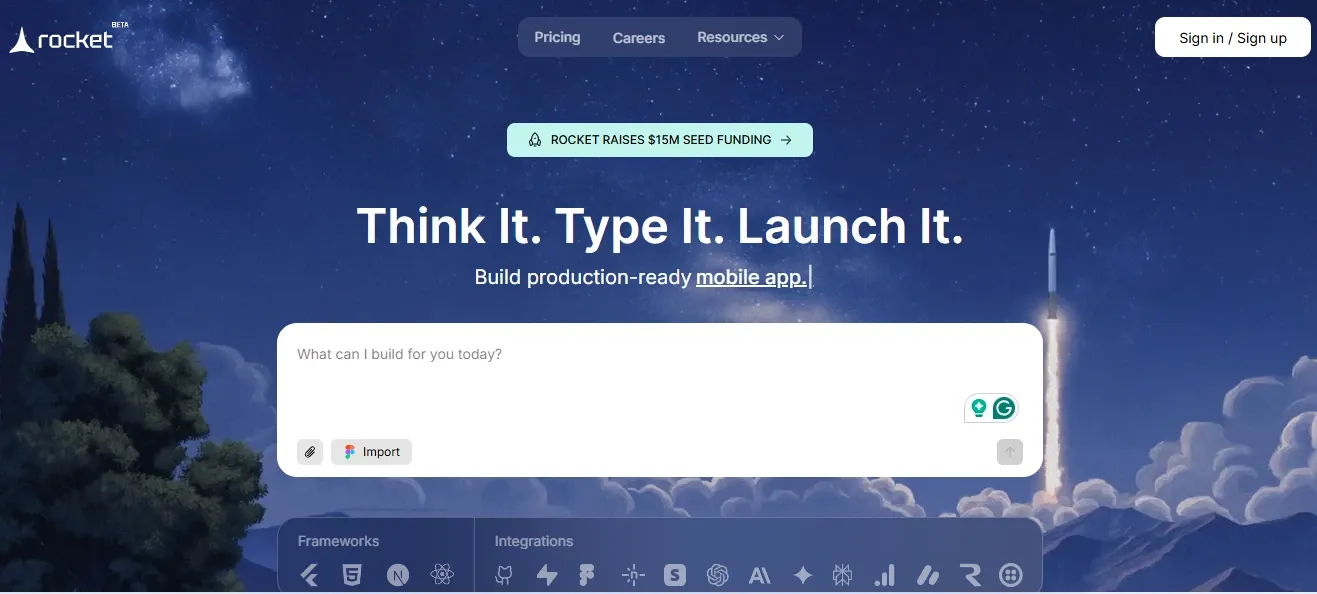
Rocket.new lets you create your Postmates clone without writing heavy code. You can build an app like Postmates through simple prompts and tweak every detail from user flow to database structure.
Here’s how Rocket helps:
For technical founders, this approach removes repetitive setup work and lets you focus on user experience, store partnerships, and growth.
A well structured clone app should support different service verticals such as food delivery, grocery delivery, courier, or even pharmacy. The multi delivery app model allows more efficient use of delivery drivers and increases ROI. With a clear delivery management dashboard, you can monitor every delivery location and performance data.
To scale smoothly:
By combining operational data with technology, you maintain control while expanding reach.
A real example shared on LinkedIn provides context for how teams deploy white-label delivery systems quickly.
“We built a white label delivery platform in just 90 days using a postmates clone framework. It handled 10,000 plus daily orders and supported food and grocery delivery from day one.”
This demonstrates that experienced teams value flexibility and rapid iteration over building everything from scratch.
Choosing your vendor isn’t only about features. It’s about the partnership.
Experts often negotiate a technical review before final purchase to confirm architecture stability.
Even experienced founders slip when operations scale too fast.
Every missed metric in delivery management translates directly into loss of efficiency and customer trust.
As delivery services diversify, clone scripts are evolving too. Expect smarter route algorithms, AI driven driver scheduling, and predictive ETA models. Demand delivery platforms will likely merge with subscription services for premium customers. Payment gateways will expand with crypto and digital wallets. The goal is to create a unified delivery experience where food delivery, grocery delivery, and even courier services coexist under one brand identity.
Launching in the delivery business is no longer about reinventing every wheel. A solid postmates clone gives you a launch ready infrastructure and room to grow. For experts who understand logistics and scaling, this is not about imitation, it’s about acceleration. Focus on your operational model, build differentiation into your service, and let the technology handle the heavy lifting. With Rocket or a similar builder, you can translate that plan into a live product in weeks, not months.